



What is Marble? | Composition, Texture Formation, and Material Characteristics
- Marble is a metamorphic rock formed by the metamorphism of limestone under high temperature and pressure deep within the Earth's crust over geological time scales. During the metamorphic process, the minerals within the rock recrystallize, and the uneven distribution of various impurities such as iron oxide and graphite creates marble's rich, naturally flowing unique texture. Since it is formed by natural geological processes, each slab exhibits a unique pattern that cannot be fully replicated artificially. Consequently, subtle differences in color and texture may exist between slabs from the same batch, which is a normal characteristic of natural stone.
- Marble is primarily composed of calcium carbonate (CaCO₃), along with minerals such as magnesium carbonate and silicon dioxide. It has a Mohs hardness of approximately 3 to 5, making it relatively softer compared to granite (hardness 6 to 7). It is easy to polish and can exhibit a smooth, fine luster, but its surface is more prone to scratches from hard objects. With a density of about 2.6 to 2.8 g/cm³, its considerable weight necessitates careful consideration of load-bearing capacity when crafting furniture or during installation.
- The interior of the stone contains fine pores and a relatively loose structure, making it prone to absorbing oil stains and pigments, which can lead to staining. When calcium carbonate reacts with acidic substances such as vinegar or fruit juice, it undergoes a chemical reaction, corroding the surface and causing it to lose its luster. Marble itself is highly brittle. As a professional stone manufacturer, we implement standardized protective measures throughout the entire process of processing, transportation, and packaging to minimize the risk of stone breakage..
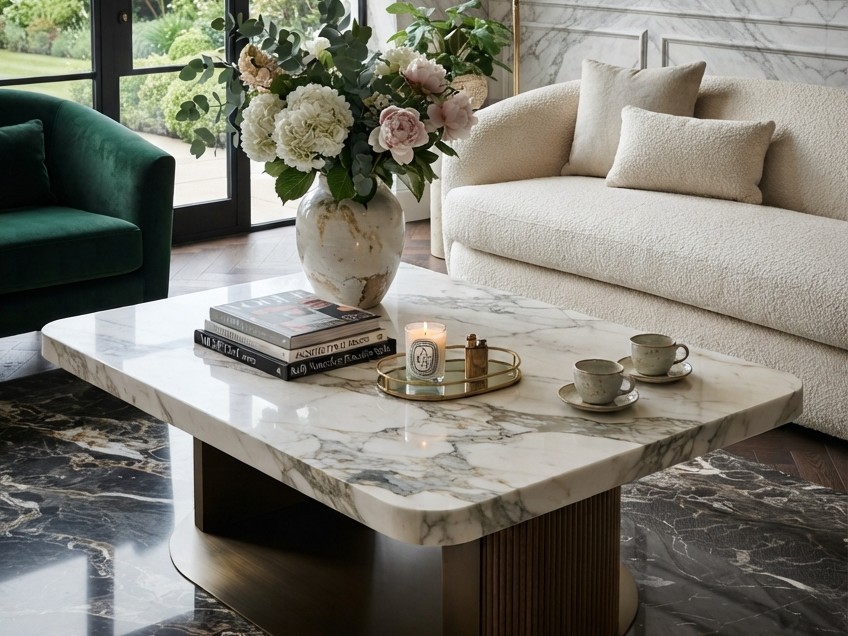
- Natural marble, with its irreplicable texture and grain, is commonly used for countertops, washbasins, and interior decoration, serving as a classic material to enhance spatial quality. When purchasing, do not rely solely on images or sample catalogs. It is recommended to inspect the actual slab in person to confirm the surface, color variations, and flaws, avoiding significant discrepancies between expectations and the physical product.
Advantages and disadvantages
✅ Advantage
1. Unique texture: Each piece of marble has a unique natural pattern that cannot be replicated by artificial materials, giving the space a unique texture and personality.
2.High quality and warm texture:The polished surface is delicate and smooth, with a soft luster and outstanding decorative visual effects, enhancing the overall grade.
3. Excellent temperature control performance: Moderate thermal conductivity, with a cool touch sensation, suitable for underfloor heating environments, and uniform heat conduction.
4.Possess value preservation properties: High quality marble decoration has a certain supportive effect on property value.
⚠️ Shortcoming
1.Easy to infiltrate color pollution: The stone has its own capillary pores, and if colored liquids such as coffee, red wine, soy sauce are not cleaned in time, they can easily infiltrate the stone and form permanent color spots.
2.Low hardness and easy scratching: Compared to granite and quartz, marble has lower hardness and sharp hard objects are prone to leaving scratches on the surface.
3. There is a risk of acidic corrosion: Acidic liquids in contact with the surface of the board can corrode the stone and damage the surface gloss.
4.High self weight: Stone has high density and weight, and when used for countertop or floor installation, it is necessary to evaluate the structural load-bearing capacity in advance.
5.High cost: The material and processing costs are relatively higher, and regular maintenance is required in the later stage, with high maintenance costs.
6. Anti slip Limitations: The wet anti slip performance of glossy marble is average, and it is recommended to use a matte surface in damp areas.